Choose a Fur Bag by Opening, Carrying Position and Daily Use
Choose a natural fur bag by checking the usable opening, your essential contents, the strap and the materials of the complete bag. Fur changes the visual texture, but it does not tell you the lining, capacity or carrying comfort. Compare the selected product with your phone in its case and the coat you will wear. Then decide whether its shape and care fit a real role in your wardrobe.
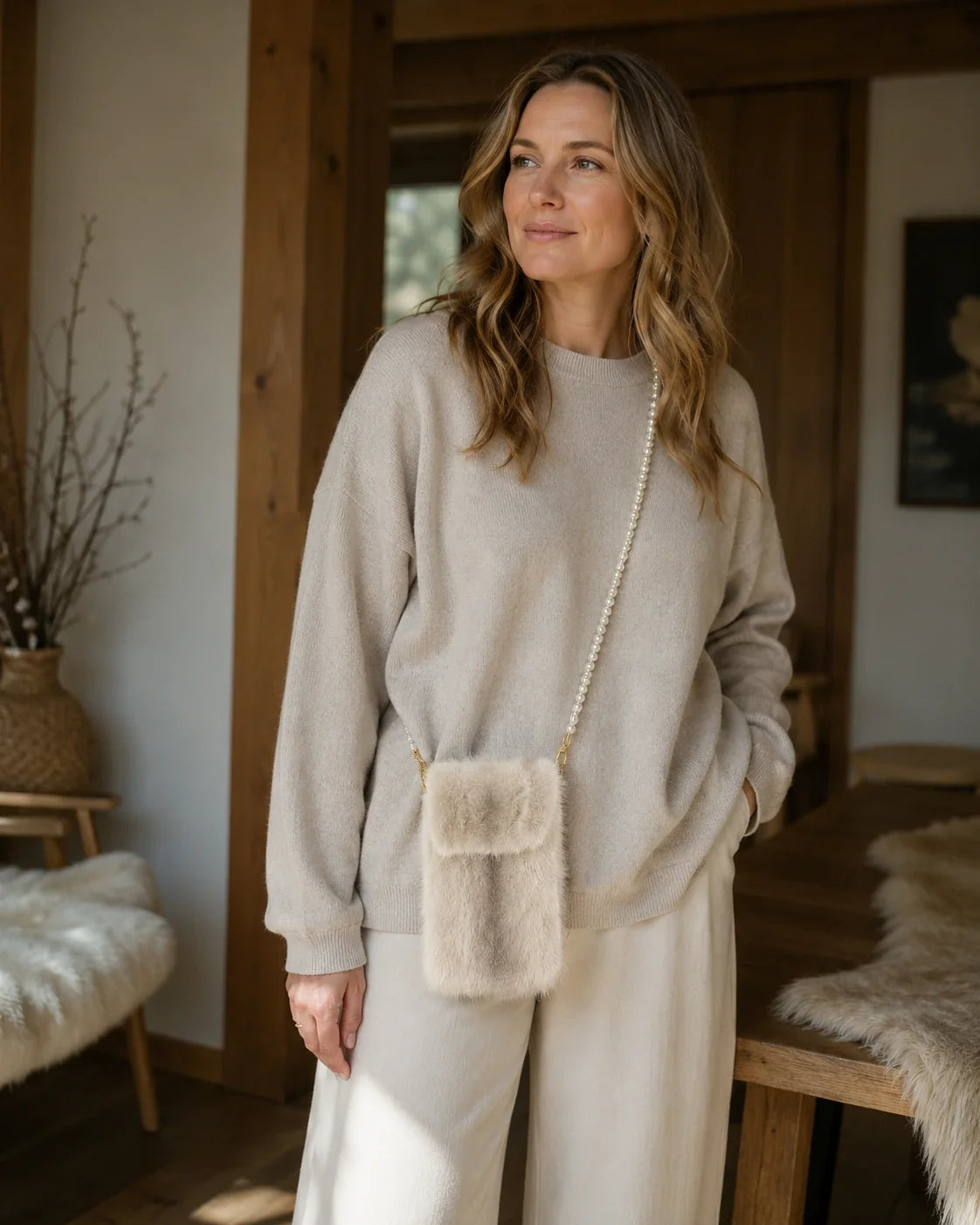
Choose a natural fur bag by checking the usable opening, your essential contents, the strap and the materials of the complete bag. Fur changes the visual texture, but it does not tell you the lining, capacity or carrying comfort. Compare the selected product with your phone in its case and the coat you will wear. Then decide whether its shape and care fit a real role in your wardrobe.
Give the bag one clear job
Before looking at colours, choose the journey the bag is for. A phone-focused evening accessory, a small everyday crossbody and a decorative hand-held bag can all be useful without carrying the same things. The mistake is expecting a compact occasion shape to behave like the larger bag you use for a full working day.
Lay out the essentials for that journey. Include the actual wallet, keys and phone case rather than the smallest substitutes you own. Remove the just-in-case objects you rarely use, but do not remove something necessary merely to make a preferred bag seem suitable. This small edit gives the purchase a realistic capacity brief.
Look past the outer volume
Fur can create a generous outline around a relatively compact bag body. Ask for the dimensions of the body and opening, and clarify whether a measurement includes decorative volume. A width photographed across the outer fur is not automatically the width available to your belongings. The opening may be more important than the widest part of the body.
For a phone, compare length, width and thickness with the case attached. Consider how you will angle it through the opening without forcing the closure or compressing decorative material. If usable internal measurements are not given, request them. A title that includes phone bag is not a guarantee for every device on the market.
Choose the carrying position with your coat on
Try the bag where you intend it to sit: across the body, on the shoulder or in the hand. A winter coat adds a different layer from a light indoor outfit, so compare the strap over that coat. Ask for the adjustment range and how it is measured. Strap length and vertical drop are related but not interchangeable descriptions.
Notice whether the bag rests where you can reach it comfortably. If it sits too high, the opening may be awkward; if it sits lower than you want, it may meet another part of the outfit. These are personal fitting observations, not rules assigning a fixed drop to a particular height. The useful position is the one that works for your body and routine.
Read the strap as a component
A decorative chain, webbing strap, leather strap and bead-like strap can create different visual effects and handling experiences. Confirm the actual material and whether the strap is fixed, removable or adjustable. Do not infer real pearls, a precious metal or a load rating from appearance or a style name.
Inspect the connection points in the product images and ask about the intended carrying arrangement. A small loop used for decoration should not be treated as a handle. If you want to change the strap, confirm that the bag is designed for it and that the replacement is appropriate. A clip that physically fits does not establish suitability for the complete bag.
Understand the exterior and the interior separately
Look for the named fur material and which panels contain it. Then read the reverse, lining, trim and fastening descriptions. A fur outer surface does not establish a fur interior. A leather lining does not automatically make the bag waterproof or protective for electronics. Each useful claim should describe a real component or tested function.
Our women's mink fur phone crossbody bag is listed with a mink fur exterior, cowhide lining and a pearl-style strap. These details identify distinct parts of the accessory. They are a starting point for evaluating the design, not a promise of universal phone fit, genuine pearl content or protection against drops and spills.
Test access as a short sequence
Open the bag, take out the object you use most often, put it back and close the bag normally. If trying it in person is not possible, ask for a demonstration that shows that sequence. A picture of the bag held open may hide how the fastening works or how much room your hand needs.
Repeat the sequence with the coat and gloves you expect to wear. If the closure is difficult with gloves, decide whether removing them is acceptable for your routine. Do not judge a bag only by whether everything fits inside once. Easy retrieval and a closure that works without strain are part of usable capacity.
Consider contact with clothing and jewellery
A crossbody strap may pass over a scarf, lapel or necklace. The bag body may rest against buttons or a rough decorative surface. Try the complete outfit and move normally. If two details repeatedly catch or displace each other, simplify the pairing rather than expecting constant careful handling to solve the problem.
If colour transfer is a concern, ask for guidance specific to the bag and your intended clothing. Do not perform a wet rubbing test on a new accessory or assume that dark and light pieces are always incompatible. The useful question concerns the actual materials and finish, not a universal rule based on colour alone.
Choose an outline you enjoy in movement
A rounded bag, compact rectangular phone shape and hand-muff format create different proportions. Look at a side view and an ordinary standing view, not only a carefully cropped close-up. Decide whether you want the bag to blend into the coat or act as a visible texture accent. Both can be valid choices.
Then walk a few steps during a fitting, keeping the movement ordinary. Notice whether you keep holding the bag in place or adjusting the strap. A striking outline is easier to enjoy when it settles naturally. Do not mistake a pose that displays the product well for the only comfortable way it can be worn.
Budget for the whole ownership experience
Compare the purchase with the care you can realistically provide. Read the directions for the entire bag and ask where to seek help if the lining, strap or fastening needs attention. Do not assume that every fur-care business repairs every bag construction. Describing the actual components helps you find appropriate advice.
If you already own a suitable small bag, consider whether the new one adds a genuinely different role or simply another colour for the same outfit. There is nothing wrong with a preference-led purchase, but naming that preference honestly makes the decision clearer. A useful bag need not be justified by invented performance or environmental claims.
Check the order before first use
Confirm the selected colour, construction and included components when the bag arrives. Keep labels and packaging as required by the applicable return conditions while assessing it. Compare the opening and strap with the description, and document any concern before applying a treatment or making an alteration.
Store the product and care information where you can find it later. This makes future questions about materials, cleaning or repair easier to answer. A well-documented purchase can become a familiar part of your wardrobe without requiring you to remember every detail from the original listing.
Frequently asked questions
Are external measurements enough to check phone fit?
Not always. The usable opening, internal space and phone case all matter. Ask what the measurements represent.
Can a fur bag replace a protective phone case?
Do not assume so. A carrying accessory is not a tested protective case unless that specific function is established for the product.
Is a decorative strap suitable for every carrying style?
Use the intended arrangement and stated features. Do not infer adjustability, removability or load capacity from a photograph.
Should I start with a statement colour?
Start with the outfit and role you want. A quieter colour may make frequent use easier for you; a contrast may be the reason you enjoy the piece. Fit and access should work in either case.