Short Fur Collar or Long Fur Scarf? Start With Your Coat
Choose a short fur collar when you want a compact accent near the neckline, and consider a longer fur scarf when you want more visible length or different draping options. Those are styling starting points, not fixed rules. Compare the actual dimensions, closed arrangement and volume with your coat. The better choice leaves room for comfortable movement and has ends you can manage easily during your normal day.
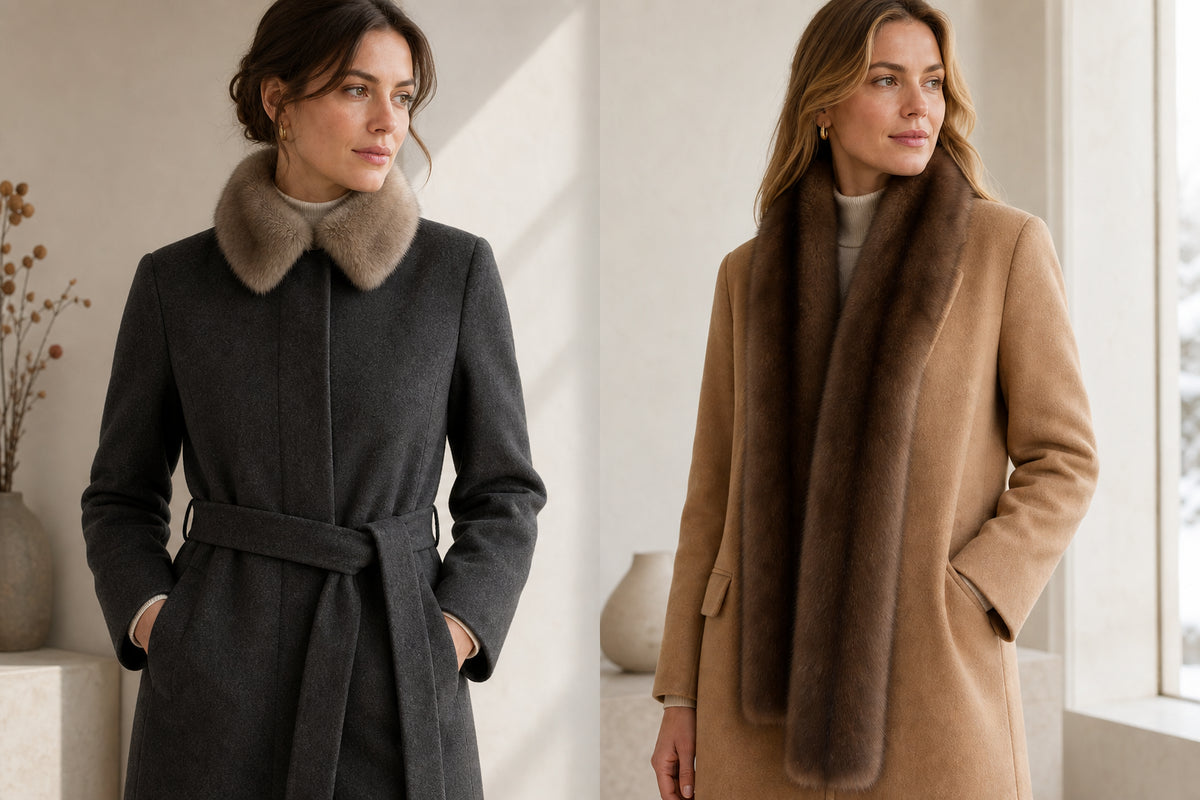
Choose a short fur collar when you want a compact accent near the neckline, and consider a longer fur scarf when you want more visible length or different draping options. Those are styling starting points, not fixed rules. Compare the actual dimensions, closed arrangement and volume with your coat. The better choice leaves room for comfortable movement and has ends you can manage easily during your normal day.
Make the coat the starting point
Put on the coat you expect to wear most often, close it normally and look at the space around the neckline. Is there a high collar already filling that area, a broad lapel framing it, or a simple opening that leaves room for an accessory? This gives the scarf or collar a real setting before you start comparing lengths.
A product photograph may show a low neckline that is quite different from yours. Rather than trying to reproduce that pose, identify what you like about it: a compact frame around the face, a longer vertical line or the contrast between textures. You can then look for that effect in a shape that works with your own coat.
Understand what short and long leave unspecified
Neither word gives you a usable measurement by itself. Ask for the full length and width, and check whether decorative ends are included. If the scarf closes through an opening or fastening, find out how the listed dimensions relate to the wearing arrangement. A long flat object does not necessarily create a long visible drop after it is closed.
Volume also matters. A short but very full collar can occupy more room at the chin than a longer, narrower scarf. A broad long scarf can create a different outline from a slim one of the same length. Compare at least length, width, volume and closure rather than using a single number to predict the entire fit.
When a compact collar is a useful starting point
A short collar can suit someone who wants the accent concentrated near the face and prefers not to manage long ends. Try it with the coat closed, particularly if you regularly carry a bag across the front. Check that the collar does not compete with the coat's own fastening or rise into an uncomfortable position when you sit.
The compact outline is an aesthetic preference, not a universal solution for small frames or particular face shapes. If you enjoy a more contained look, test it. If it feels crowded around the neckline, a different width or arrangement may work better. There is no need to accept pressure merely because the accessory is described as a neat collar.
When additional length can be useful
A longer scarf gives you more visible material to arrange, provided the design supports that use. You might prefer a vertical line over a simple coat or a softer drape with an open neckline. Ask whether the scarf is intended to hang, cross or close in a specific way before assuming it can be tied into any knot.
Then consider the ends during ordinary movement. Where do they rest when you sit? Do they cross the bag opening or meet a belt buckle? Are you comfortable managing them when taking the coat off? A beautiful long outline should not depend on holding your arms in a particular position throughout the day.
Try the same movement sequence with both
With each candidate, lower your shoulders, turn your head and reach forward as if opening a door. Sit briefly in an ordinary chair if a fitting allows it. Open and close the coat without changing its intended use. Keep the sequence consistent so the comparison reflects the accessory rather than a different pose.
Notice which adjustments you make automatically. If one piece needs constant repositioning at the chin and the other repeatedly meets your bag, those are different issues. Write them down specifically. The solution may be a different width, closure or coat pairing, not simply choosing the opposite length category.
Use colour to support the shape
Once the fit works, consider how much contrast you want. A colour close to the coat can make the accessory feel like part of the overall outline; a contrasting colour can make its shape more noticeable. Treat that as a styling suggestion, not a rule about which combinations are acceptable.
Look at the coat and accessory together in ordinary light where possible. Product photographs taken under different lighting can exaggerate a match or a contrast. If an exact colour relationship is essential, ask for additional information rather than assuming that two similarly named shades are identical. A deliberate tonal difference can also look more intentional than an uncertain near-match.
Choose one useful role before adding another piece
If you already own a long scarf that works with most coats, a compact collar may add a genuinely different option. If your existing collars all feel too concentrated at the neckline, another similar piece may repeat the same frustration. Review what you actually wear before choosing the next accessory.
An illustrative two-piece wardrobe might include one compact option for a simple everyday coat and one longer option for an open occasion coat. That is a planning example, not a required set. One well-chosen scarf can be enough. The aim is a clear purpose for each piece, not a collection of lengths that all solve the same problem.
Read the product example in its own terms
The double-sided fox fur scarf in our collection uses a pull-through opening and rounded ends. Compare that particular outline with your coat rather than treating it as the universal shape of a short collar or a long scarf. Check the measurements and ask about the closed arrangement if the neckline space is close.
Keep the care directions with the accessory and avoid using a tight knot or improvised pin to force an unsuitable length into place. If the shape only works after an alteration, obtain advice about the exact construction before changing it. A more compatible design may be easier to live with.
Common questions
Is a long scarf automatically warmer?
Do not infer a thermal rating from length. Coverage, materials, construction and the wearing arrangement all matter, and a specific performance claim needs its own support.
Can a short collar work with an open coat?
Yes, if the shape sits comfortably and creates the outline you like. Check the real neckline rather than relying on a length label.
Should I choose by height or body type?
Use those labels cautiously. The actual coat, accessory dimensions and your preferences provide a more practical basis than a universal rule assigning one scarf length to one kind of person.