How Should Sheepskin Slippers Fit? Check Shape Before Size
Sheepskin slippers should fit according to their exact design and size guidance, with room for comfortable use and no need to grip them in place with your toes. Check the foot's position on the footbed, the upper opening and the heel arrangement. A slide and a closed-toe slipper require different observations. Do not buy a painful fit on the promise that every pair will stretch or compress into the right size.
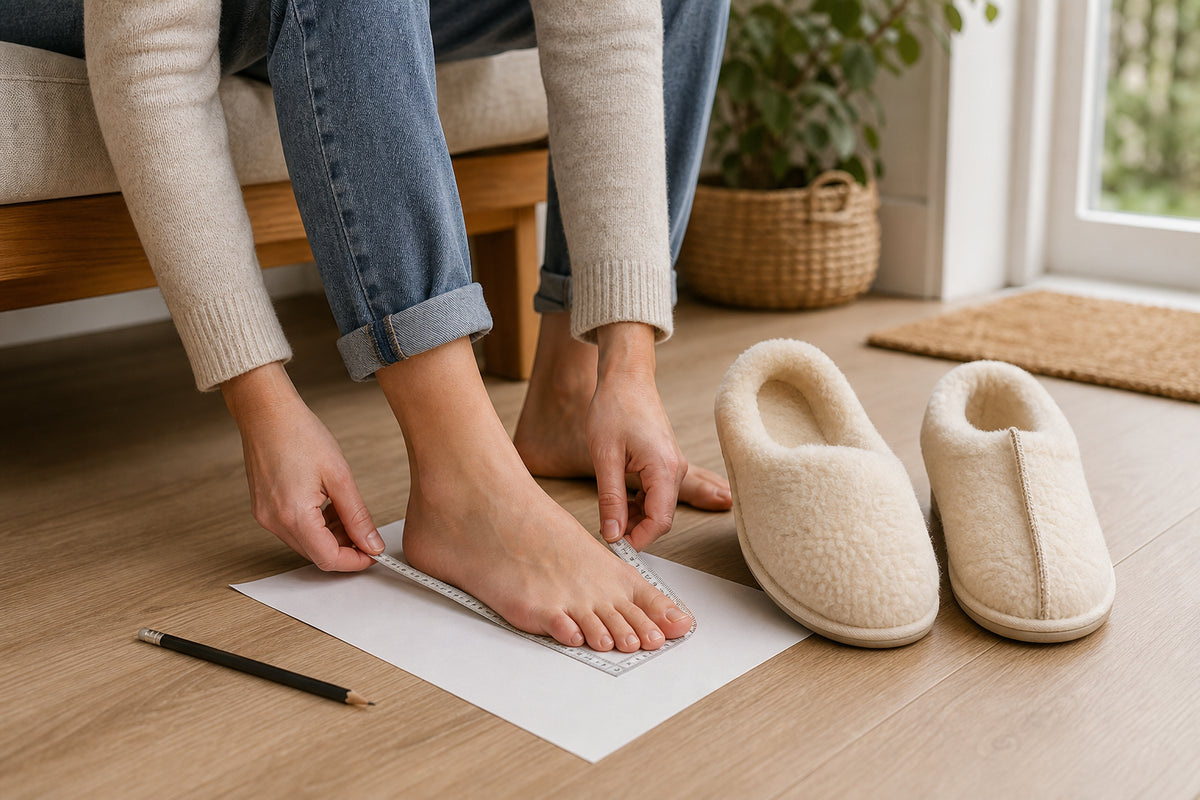
Sheepskin slippers should fit according to their exact design and size guidance, with room for comfortable use and no need to grip them in place with your toes. Check the foot's position on the footbed, the upper opening and the heel arrangement. A slide and a closed-toe slipper require different observations. Do not buy a painful fit on the promise that every pair will stretch or compress into the right size.
Identify the shape before discussing fit
An open-toe slide, a closed-toe mule and a fully enclosed slipper do not hold the foot in the same way. Start by naming the construction you are considering. A photograph from above may conceal whether the heel is open or how much of the forefoot is covered. Ask for a side view if the shape is unclear.
Then decide when you will wear the pair. A short morning routine, time at a desk and repeated trips around the home can create different preferences for coverage and easy removal. This does not mean assigning a performance rating to a silhouette. It means choosing a shape that makes sense for the way you actually intend to use it.
Measure according to the selected product
Use the maker's measuring instructions and compare with the chart for that exact slipper. Clarify whether a number describes the foot, insole or outside sole. Those dimensions are not interchangeable. Keep your original measurement and unit rather than converting it into a familiar shoe size and discarding the number.
If a product uses combined size ranges, ask how the maker recommends choosing within or between them. Do not borrow a size conversion from an unrelated brand or assume that the same label fits identically across slides and enclosed styles. If your feet differ noticeably, mention that when seeking advice rather than hiding the difference in an average.
Try the socks you plan to wear
If you normally wear slippers with socks, use the intended thickness during the fitting. If you usually wear them without socks, follow any applicable fitting and hygiene conditions while assessing that arrangement. The important point is consistency: a fit chosen over a thin layer may feel different with a much bulkier one.
Do not choose a larger size automatically just because you may sometimes wear socks. Ask how the selected design should fit and assess the actual combination. Equally, do not force a thick sock into a pair already uncomfortably close. A different slipper shape may suit a varied routine better than trying to make one size cover every possibility.
Look at the footbed position
Check where the toes, sides and heel sit relative to the intended footbed. The foot should not need to be held in an unnatural position to stay within the shape. On an open design, do not treat an exposed toe as proof of a correct or incorrect fit without considering the intended outline and size guidance.
On a closed-toe design, check that the front does not press uncomfortably and that the upper does not restrict normal movement. Do not use a universal spare-space rule from another footwear category. The maker's guidance and your comfortable position in the actual slipper are the relevant starting points.
Walk normally during a permitted fitting
Take a few ordinary steps on a clean, suitable indoor surface if the fitting conditions allow it. Notice whether the slipper stays with the foot without repeated toe-gripping or an exaggerated walking pattern. If it feels unstable or uncomfortable, stop and reassess rather than treating that as something you must learn to tolerate.
Try turning and pausing as you would during normal household use. This is a fit observation, not a slip-resistance test. Do not deliberately walk on wet or hazardous surfaces to evaluate a pair. Sole appearance or the word indoor does not establish a tested safety rating for every floor in your home.
Understand the product example
Our shearling slide slippers are described as an open-toe slide with a single wide shearling band, a wool-covered footbed, a bound edge and a low flexible sole. The listed options use EU 36–37, 38–39 and 40–41 ranges. These are the size labels for this design, not foot-length measurements. Check the fit guidance for your selected pair before choosing.
Use the product's own fit information and ask for any missing measurement before choosing. The open-toe format should not be evaluated as though it were an enclosed slipper. Likewise, a flexible sole description does not prove suitability for every surface or outdoor use. Keep fit, material and performance questions separate.
Do not rely on an assumed break-in
An upper or foot-contact surface may change with use, but that does not justify buying an initially painful pair or predicting an exact amount of change. Ask what the maker expects from the selected construction. Avoid heating, soaking or aggressively stretching the slippers to produce a size adjustment that the instructions do not support.
If the fit seems close, identify where the issue is: upper opening, toe space, width or heel retention. A precise concern makes advice more useful. It may point to another size, another shape or a different sock arrangement. Simply labelling the whole pair too small can hide the part that actually needs attention.
Keep condition and fit connected
Follow the care directions for the complete pair. If the shape or sole condition changes, reassess whether the slippers still suit your routine. Do not assume that an old size label establishes the present fit indefinitely. Equally, do not replace a pair automatically because its appearance is no longer identical to the first day.
Before first use, confirm the selected option and keep the information needed for any fit query. If you are considering an exchange, follow the current purchase conditions and avoid altering or treating the pair while the decision is unresolved. A clear record of the concern is more useful than trying to correct it through an improvised care routine.
Frequently asked questions
Should sheepskin slippers feel tight at first?
They should not be painful or force an unnatural position. Follow the exact product's initial-fit guidance rather than a universal claim about break-in.
Are combined sizes the same across brands?
Do not assume so. Compare the selected product's chart and clarify the measurement basis.
Can a soft sole guarantee quiet or secure steps?
No universal guarantee follows from that description. Consider the stated intended use and your actual floor conditions, without treating appearance as a performance test.