Knit-Crown or Leather-Crown Trapper Hat? Compare the Whole Hat
Compare knit-crown and leather-crown fur trapper hats by their stated composition, structure, lining and fit range, not by assuming one is always softer, warmer or easier to pack. The crown is only one part of the hat; earflaps and trim may use different materials. Choose the silhouette and wearing arrangement that work with your head, hairstyle and coat, and follow care instructions for the complete construction.
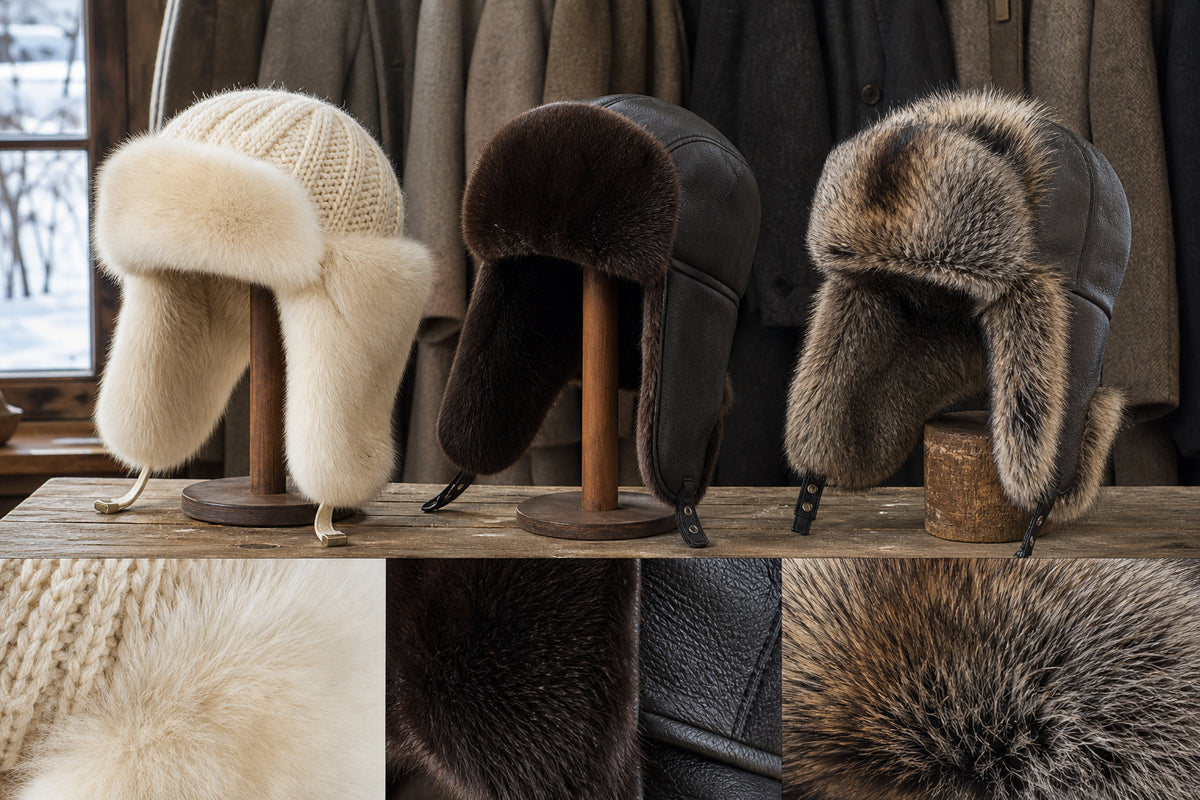
Compare knit-crown and leather-crown fur trapper hats by their stated composition, structure, lining and fit range, not by assuming one is always softer, warmer or easier to pack. The crown is only one part of the hat; earflaps and trim may use different materials. Choose the silhouette and wearing arrangement that work with your head, hairstyle and coat, and follow care instructions for the complete construction.
The crown description is only the beginning
The crown is the part that sits over the head, while the earflaps and visible trim form other parts of the trapper silhouette. A product title may emphasise the fur and leave the crown material less prominent. Read the whole description so that you know what each component contains before comparing two hats.
Do not treat knit as a fibre name. A knitted crown still needs a composition description. Likewise, leather needs an animal or material description and relevant finish information where provided. These details should correspond to the exact hat you are considering, not a general collection statement that covers several different constructions.
A side-by-side shopping checklist
| What to compare | Knit crown | Leather crown |
|---|---|---|
| Material | Check the fibre composition; knit names a construction. | Check the leather type and the described finish. |
| Opening and fit | Look for a stated range; a knitted surface is not a size chart. | Look for a stated range and any designed adjustment. |
| Inside the crown | Check lining coverage and the surface against your forehead. | Check lining coverage and the surface against your forehead. |
| Packing | Confirm whether the assembled hat can fold or compress. | Confirm whether the assembled hat can fold or compress. |
Compare structure without assuming a result
A knit-looking crown may suggest flexibility, while a leather crown may look more defined in a photograph. Those impressions are not enough to establish the actual fit range, stiffness or shape retention. Linings, seams and other construction details can influence the finished hat. Ask for the stated fit guidance and an ordinary wearing view.
At a fitting, let each hat settle in its intended position without stretching it into place. Notice the outline and where the crown ends relative to your ears and eyebrows. The question is not which material wins in the abstract, but which actual hat gives the shape and comfortable position you want.
Keep size and adjustability separate
Measure your head at the wearing line and compare with the selected product's guidance. If the hat has a size range, ask whether it refers to head circumference or another dimension. If it has an adjustment, identify where that adjustment acts. A feature at the earflaps does not necessarily change the crown opening.
Do not assume that a knitted crown fits everyone or that a leather crown cannot have adjustment. Both conclusions skip the product's construction. Use only the stated mechanism and do not stretch, wet or heat a hat to reach the size you hoped it would be. A material stereotype is not a fitting instruction.
Check the lining rather than imagining it
The interior can affect the wearing experience independently of the outside appearance. Ask what the lining is made from and whether it covers the whole crown. A soft-looking exterior does not establish the surface that will contact your hair or forehead. An inside photograph can help explain the arrangement but should be paired with clear information.
If lining composition is missing and important to you, ask directly. Do not infer it from another hat in the same collection or from the words winter and warm. The seller may be able to provide the answer, and if not, you can compare a different product whose construction is more fully described.
Use the same outfit for both fittings
Wear your usual glasses, hairstyle and coat when comparing the two candidates. Close the collar, turn your head and look down comfortably. Notice whether the rear crown or earflaps meet the coat. Keep the sequence the same so that you are comparing the hats rather than two different outfits or poses.
If one pairing feels crowded, identify where. A crown sitting too low is different from an earflap meeting a high collar. You may need another size, another shape or another coat combination. Choosing the opposite crown material does not automatically solve all three problems, so keep the observation specific.
Think about indoor transitions
Consider how often you remove the hat during a normal day and where you place it. If compact carrying is important, ask whether the complete hat is designed to fold or pack in the way you intend. A flexible-looking crown does not establish that its fur, lining and attachments can be compressed without concern.
Do not use a large handbag as evidence that either construction is easy to store. Try the actual space available, following the maker's handling directions. A hat can suit an outdoor routine where it stays on for longer and be less convenient for frequent indoor stops. That is a practical distinction worth making before purchase.
Choose the visual relationship with the coat
A crown that contrasts with the fur can make the construction a visible feature. A closer tonal relationship may create a quieter outline. Compare those effects with your coat's surface and colour. These are styling options, not claims that one material belongs only with casual clothing and another only with formal clothing.
Look at the side and back views as well as the face-framing photograph. The crown occupies much of the hat's visible surface, especially when you turn. Choose an outline you enjoy from ordinary angles rather than one that works only in a tightly cropped front portrait.
Read care for the assembled object
A knitted component and a leather component may have different general care associations, but the finished hat combines materials. Do not separate those associations into a homemade routine. Follow the instructions for the whole hat, including fur trim and fastenings, and ask for clarification where the directions are incomplete.
If the crown or lining changes shape, document the issue and ask before attempting to restore it. Production techniques and general fabric-care advice do not necessarily apply to the assembled accessory. A clear description of the affected area will help a suitable professional assess the problem more accurately than the crown label alone.
Questions about the comparison
Is a knit crown always stretchier?
Do not assume a useful fit range from appearance. Ask for the construction and stated size guidance of the actual hat.
Is a leather crown waterproof?
The material name alone does not establish waterproof performance for the complete hat. Look for an applicable product-specific claim if that function is required.
Which is warmer?
There is no supported universal ranking here. Coverage, lining, construction and conditions matter. Choose on confirmed features and obtain appropriate performance information for any specific protective need.
Can I wash the crown separately from the fur?
Only if the product is explicitly designed for that separation and gives suitable instructions. Do not detach or treat one part on the assumption that the rest of the hat will be unaffected.